• About us
  • The Church of Jesus Christ
  • The Family
  • The Living Christ

4 Brothers Blog

4 Brothers Blog

Author Archives: Tyson Alexander

The Shining of a Flaming Fire

08 Wednesday Jul 2015

Posted by Tyson Alexander in Temples

≈ Leave a comment

Photo by Rick Satterfield – taken from ldschurchtemples.com

We have all heard that the world is becoming increasingly dark – and it is true.  “The world and the wisdom thereof”1 is clamoring to become an even louder and more influential voice among us, and its “dark clouds of trouble hang o’er us and threaten our peace to destroy” yet we can rest assured that “there is hope smiling brightly before us, and we know that deliverance is nigh”.2 

All over the world and “upon all the face of the earth”, we will find “the church of the Lamb”, and even though our “dominions upon the face of the earth [are] small” we can and will be “armed with righteousness and with the power of God in great glory”.3  

Symbolism is so powerful, and we have “the great symbol of our membership”4 that we can look to every single day to learn exactly how to live in these perilous times.  Every single day, and literally spread throughout the whole earth, there are beautiful temples standing firm, tall, and glorious as a symbol of “all we hold dear”. 5 And each night as the sun goes down and the darkness of night gathers around that temple – it begins to shine.  That darkness comes slowly, and as it does the soft light of the temple begins to glow and we may not even notice it until the natural light of the day is completely gone and darkness is nearing its peak – but each great edifice, each great symbol, stands as a magnificent contrast to the darkness surrounding it as it glows with “the shining of a flaming fire”6 for all to see.

We have learned that “Fire is a symbol for cleansing, purifying, or sanctifying, and that it can also serve as a symbol of God’s presence”7 – and nowhere is this more true or symbolically visible than in his own house when that flaming fire is against a backdrop of complete darkness – it is a reminder for each of us to “stand with brightness” in a world full of darkness – for the whole world to see.

The temple is much more that just a building, and much more than just a sacred place – although it is that.  The temple as a symbol stands for everything that we as latter-day saints proclaim to the earth as unique truth restored through Joseph Smith and the whole reason for existence.  It is the one and only place on earth where eternal families can be forged, where we can learn about where we came from and who we really are.  Each mighty temple is “a standing witness that the power of God can stay the powers of evil in our midst”. 8 It is a constant reminder of the ideal and atoning sacrifice of our savior, how to be like him, and what he did for us.

The world is becoming increasingly dark – this is true – but the world is also becoming increasingly bright.  Each day and each month and each year, there are more and more people and families and homes that have started to glow brighter.  As that darkness becomes more intense, so must our brightness and when the natural light of the day is gone and darkness is found everywhere, we must be found standing tall and firm and true as “the shining of a flaming fire” as a very visible contrast to the prevailing darkness of the world.  Let us all stand with the light of the world, and the light of all truth – even Jesus Christ – and continue to fill the world with that light.

Notes

1 1 Ne. 11:35

2 Hymns, no. 196

3 1 Ne. 14:12-14

4 The Great Symbol of Our Membership, by President Howard W. Hunter, Oct. 1994 Ensign

5 Priceless Blessings of the House of the Lord, Teachings of the Presidents of the Church: Ezra Taft Benson (Chapter 13).

6 2 Ne. 14:5-6, see also Isaiah 4:5.  As Isaiah mentions, the temple is very much a “cloud and smoke by day and the shining of a flaming fire by night”.  I think it’s also appropriate the point out that there are 3 places referenced where his glory shall be as a defense and a refuge; the first is “every dwelling place of mount Zion” (our homes), the second is  “her assemblies” (wards, stakes, meeting places), and the third is  “the tabernacle” (the temple).

7 The Guide to the Scriptures – Fire

8 Priceless Blessings of the House of the Lord, Teachings of the Presidents of the Church: Ezra Taft Benson (Chapter 13).

Share this:

  • Tweet
  • Email a link to a friend (Opens in new window) Email
  • Print (Opens in new window) Print
  • Share on Tumblr
  • Share on Reddit (Opens in new window) Reddit
Like Loading...

Prize Winning Humility

06 Monday Jul 2015

Posted by Tyson Alexander in Humility, Pride

≈ Leave a comment

A little while ago (in November of last year), I wrote here about humility and my absurd lack of it as a character trait.  It was such a deficiency back then that I even wrote, “I think the lack of this trait (in it’s purest and truest form) really was and still is my biggest weakness – or at least one of them”.  Combined with that (my own) realization of non-humility was a conversation I had with someone whose opinion I value that told me (in a very nice way) “you need to become acquainted with real humility.  Not just to know what it is in general terms, but to really understand it and feel it”.  So, I made a personal goal to become the most humble person ever.  I vowed that there would be nobody better at being humble than me.  I wanted to be the best at being humble.

Now it’s July, and coincidentally after quoting myself, I am happy to report that I have worked very hard on my humility over the past few months – and I think I have successfully become much more humble.  In fact, I might be eligible for the “most improved humility award”.  If nothing else, I am way more humble than I used to be.  Like…. way more.  In fact, my humility has increased to the point that I can look around and be confident that I am more humble than most of the people that I see.   I have come so far in so little time.

Then today something weird happened.  It was like someone changed the rules for acquiring humility without telling me; or at least someone tried to add something to the rulebook that wasn’t there before because what I read today was so different that it just sounded wrong.  I had spent the past several months focusing on my humility, my improvement, and my progress – including how the effects of my focus and improvement had further increased my humility – only to read that “true humility is not thinking less of yourself; it is thinking of yourself less.” 1

Because I had recently spent a lot of time thinking about myself and working on my own humility (which took a lot of time thinking less of myself), I knew that anything that told me to worry about other people in order to increase my humility must be incorrect; after all, how could worrying about or trying to solve other people’s problems help with my humility?  So, I read it again sure that I had indeed misread it the first time.  Then I read it again, and again, and again just to be sure I hadn’t suffered a mild stroke and lost the ability to comprehend sentences – because I am also a really good reader.

That was when I put 2 and 2 together to make 5 because there was no way that focusing and worrying and caring about other people, helping them with all their problems, making sure that they have everything they need, and helping them achieve all of their goals could help me at all – in fact, if I listened to that advice and spent all of my time doing things for others I wouldn’t have any time to worry about myself or work on my own humility, which means I would never improve myself or get to tell people how successful my quest for humility has been by writing a blog post.

So, in an effort to become yet even more humble, I will be spending all of my free time working individually on my own humility, because you never know when the Lord will need a super duper humble guy, and I for one want to be ready and operating at the peak level of humility for when he calls.

Notes

1 CS Lewis wrote this in Mere Christianity

Share this:

  • Tweet
  • Email a link to a friend (Opens in new window) Email
  • Print (Opens in new window) Print
  • Share on Tumblr
  • Share on Reddit (Opens in new window) Reddit
Like Loading...

A Trip Across the Ocean

28 Sunday Jun 2015

Posted by Tyson Alexander in Journeys, Types

≈ Leave a comment

There is a story – a true story.  About a ship, a family, and their journey to a better place.  This story is much more than just a nice story about a trip across the ocean, which is why it was selected among the thousands of other stories written long ago to be included in the “most correct of any book on earth.”1

Nephi and his extended family had gone through many afflictions and struggles in order to build a boat (not after the manner of men) from scratch that would allow them to cross the great waters.  This was no easy task, yet together they persevered, built the ship, gathered many provisions, boarded the ship and then set sail for a better world.  During this sailing trip they were “driven forth before the wind towards the promised land”2  and things were looking up.  Struggles and sacrifice had created strong familial bonds, humility, gratitude, and hope, and traction to move forward to another new beginning.

On this journey, after they “had been driven forth before the wind for the space of many days”3 a portion of his family on the boat “began to make themselves merry… to speak with much rudeness, yea, even that they did forget by what power they had been brought thither, yea, they were lifted up unto exceeding rudeness.”  Happiness and prosperity and progress had given way to rest, which led to complacency, which always results in forgetfulness.

Fearing that this rudeness and forgetfulness would incur the displeasure of God, and because he knew that this whimsical merriment and exceeding rudeness would no doubt have detrimental consequences to everyone aboard the ship, Nephi “began to speak to them with much soberness; but rather than pay attention to his words, “they were angry with [Nephi]” because they did not enjoy him to telling them what was right.4  Nephi warned them that their behavior was inappropriate.  He even warned them “with much soberness.”  Much soberness is code for “he told them in very plain terms that what they were doing was a bad idea and that they should stop.”  We might even say that he used words like ‘declare’ or ‘warn’).  These people thought and assumed that it was their right to have a little fun, and to decide what was okay and not okay all by themselves, and therefore paid little heed to his words.  In fact, they became angry at Nephi because of his words, and rather than give heed to his warnings they let their anger lead them to action.

Laman and Lemuel took it upon themselves to enforce their opinions by constraining Nephi.  Nephi explained; they “took me and bound me with cords, and they did treat me with much harshness”.  As this was happening, Nephi demonstrated no amazing show of power, called down no “signs” from heaven to thwart the mutiny, and likely just calmly yet unmistakably made his position known.   Essentially, Nephi allowed Laman and Lemuel to make their choice and to practice their agency.   The Lord (and Nephi) – just like he has in many other instances, and just like he does today – “did suffer it that he might show forth his power, unto the fulfilling of his word which he had spoken.”5  The Lord provides agency to everyone, and everyone means everyone, even when what those people are choosing is harmful.

At this point, I imagine that those individuals who bound Nephi with cords, and who treated him or spoke to him with much rudeness were quite pleased with themselves.  Their actions may have even been met with cheers and applause from others who were tired of Nephi preaching to them about Gods expectations and their behavior – and more importantly about the age-old promise of punishment for disobeying the commandments.  Perhaps they thought that now that Nephi was bound and captive they could be at peace, or that Nephi would change his mind about what is acceptable behavior when he realized and watched their seemingly innocent merriment had not brought forth immediate negative consequences or even when it was explained to him that exceptions should be made to laws while traveling on a boat, after all – times were different now.  It wasn’t the golden days of Jerusalem or the old world any more; they were in a new world on the ocean, they had grown up and things had changed.

There is a critical detail that Laman and Lemuel either didn’t consider, or didn’t think was important enough to worry about in their celebrations.  Nephi was the navigator of the ship.  He was the one that could read the compass.  He was the one that knew where to go and how to get there.

As soon as Laman and Lemuel had tied Nephi up, “the compass that pointed the way whither they should go”6 – “did cease to work”. 7  These two (Laman and Lemuel), and all of their followers – in their haste to be comfortable with their own merriment and by attempting to silencing any naysayers by force – had forfeited their navigational capabilities all in the very same act for which they were celebrating victory.

At this point in the story, a tragic observation is captured in the record.  A simple yet profound truth that reads “they knew not whither they should steer the ship.”8  It wasn’t just that they couldn’t steer the ship – although it was that too. These guys knew the hopeful destination existed but they had no idea how to get there.  These are the guys that wanted to be in charge of the ship and wanted to tell everyone on board that despite what Nephi was saying, that everything was going to be fine, and as a side note they didn’t want anyone else making things difficult for them along the way.  This was okay for a little while; a few hours, maybe even a few days, but some time after their we-tied-Nephi-up party “there arose a great storm, yea a great and terrible tempest, and [they] were driven back upon the waters.”9

As with all decisions to disobey God’s law and/or to ignore the warnings of the prophets, at some point unfavorable consequences are guaranteed to follow.  As soon as this storm came around some of the other passengers on the boat likely  started to see that Nephi had been right all along, and were became uncomfortably aware of the situation.  The only way to peace and safety was to do exactly what Nephi had told them; obey to the Lord, be humble, repent, and keep the commandments.  Everything else is the opposite of that law and will eventually end up in pain and regret.

As this storm worsened, and the situation became dire, Laman and Lemuel “began to be frightened exceedingly lest they should be drowned in the sea; nevertheless, they did not loose [Nephi].”10  They continued in their ignorance and likely shouted loud enough for everyone to hear that Nephi was still the crazy one and promised that the storm will pass soon enough.  They probably even told everyone that the storm had nothing to do with Nephi being bound and that it was just a coincidence.

It wasn’t until these two brothers understood that “the judgments of God were upon them, and that they must perish” that they realized the mistake they had made.  They finally understood that despite their hopes and dreams, they really had no idea what they were doing.  They didn’t know how to steer the ship.  To make matters worse, during this tempest, “they (Laman and Lemuel) did breathe out much threatenings against anyone that should speak for [Nephi]”11 or who shared Nephi’s values.  They didn’t show any concern for the other passengers on the boat or how the very real consequences of their actions affected all of them.  They didn’t do what was best for the entire group.  They did what they wanted to do and demanded that everyone allow them to do it – and threatened them to stay quiet about any reminders to the contrary – even if it meant death by tempest for every single person aboard the ship.

Only when Laman and Lemuel saw that “they were about to be swallowed up in the depths of the sea” and they finally understood that they had willingly forfeited the right to proper navigation by trusting in themselves and in their own judgment rather than the Lord and his compass did they truly see.  In other words – after being driven backwards upon the waters, and after experiencing a mighty tempest that threatened to destroy the entire party, it wasn’t until they came to the point of their own imminent death did they “hear” the words and warnings that Nephi had spoken.  It is a sobering fact indeed to realize that they really may have only been in it for themselves all along.

Yet, in a flash of long overdue wisdom, these two repented, loosed Nephi from his cords, and he (Nephi) ”took the compass, and it did work whither [he] desired it.  And it came to pass that [he] prayed unto the Lord… and the winds did cease, and the storm did cease, and there was a great calm.”12  Following that, “Nephi did guide the ship, that [they] sailed again towards the promised land.”13  Problem solved, crisis averted, lessons learned, and they were back on course.

The solution to surviving the great and terrible storm was so simple, and the solution to our great and terrible tempest is still so simple.  Follow the prophet, because “he knows the way.”14  The prophet and his apostles are the ones that can use the compass and that “know whither to steer the ship”.  If we try and put ourselves in charge, by discounting their words or their counsel, ignoring them, or becoming angry with them (essentially binding them), we run the risk of veering off course and being driven backwards.

The last note about this story that I feel is important for us all to remember, is the fact that everyone in the story – both the people who were listening to Nephi and the people who were not – were in the same boat – literally.   They were all experiencing their own individual journeys within the group journey.  The interaction between the two groups was necessary, because after all, “it must needs be that there is an opposition in all things”15 and that includes opposition in opinion and the use of our agency.  I highly doubt that Nephi and his immediate family reacted to his being bound by cursing Laman and Lemuel or calling them names, shunning their families, throwing their hands in the air, losing hope, or asking to take the emergency raft to the nearest island where they could live by themselves – even if that’s what they wanted to do.  I am positive that Nephi and his family didn’t begin to “speak with much rudeness” towards Laman and Lemuel.  I like to think that they fervently prayed and continued to exhibit faith and even let Laman and Lemuel know of their love for them as members of their family and boating party, all while continually declaring and enforcing their values and where they stood on the issue by their quiet yet powerful examples of faithfulness and humility to the Lord.

We are all on a journey.  We have someone who is steering the ship and even better than that; there is someone that is causing the wind to blow – which drives our boat towards the promised land.  The Lord is in charge, and we do not need to doubt that fact.  Let us follow his enticings, be loyal to him, and act like him to be quiet yet powerful examples and demonstrate where we stand by shining with brightness, love, kindness, and hope.

Notes

1 See the Introduction to the Book of Mormon Another Testament of Jesus Christ

2 1 Ne. 18:8

3 1 Ne. 18:9

4 1 Ne. 18:10

5 1 Ne. 18:11

6 1 Ne. 16:10

7 1Ne. 18:12

8 1 Ne. 18:13

9 1 Ne. 18:13

10 1 Ne. 18:13

11 1 Ne. 18:17

12 1 Ne. 18:21

13 1 Ne. 18:22

14 Children’s LDS Songbook, 110, “Follow the Prophet”

15 2 Ne. 2:11

Share this:

  • Tweet
  • Email a link to a friend (Opens in new window) Email
  • Print (Opens in new window) Print
  • Share on Tumblr
  • Share on Reddit (Opens in new window) Reddit
Like Loading...

Not Papaya Juice

25 Thursday Jun 2015

Posted by Tyson Alexander in Food, Opposition, Silence, Trials

≈ Leave a comment

Something awesome happens when you squeeze an orange.  Juice comes out.  It doesn’t matter whether it is sliced in half and then squeezed with hands directly into a glass or chopped up in big pieces and thrown into a juicer, or even if it is peeled and then ‘juiced’ by my teeth and they chomp up and down, the fact of the matter is that regardless of the particular method of squeezing involved, the juice that is inside that orange is going to come out under pressure.

How strange would it be if we squeezed an orange, only to find something other than orange juice?  Perhaps it could be apple juice, pear juice, or if you are really unlucky it could be guava or a papaya juice – or worse still a glob of black goo.  That’s when you just throw it in the trash (papaya and goo).  We would label it as a Pharisee fruit and shake our heads in disgust wondering what on earth went wrong.

Fruit is a product of a tree1, and rightfully and literally is called the fruit – not just because that’s its name, but also because it is a literal product of, or the end result of the growth process of that tree/vine/bush.  In this sense, the juice that is inside the fruit could be considered the fruit of the fruit – or the end result of that fruit’s maturity – or in other words, what it ultimately has to give at the end of it’s life cycle (when its time to be squeezed).

Paul taught, “the fruit of the Spirit is love, joy, peace, longsuffering, gentleness, goodness, faith, meekness, temperance”. 2 Peter added, “beside this, giving all diligence, add to your faith virtue, and to virtue knowledge; and to knowledge temperance; and to temperance patience; and to patience godliness; and to godliness brotherly kindness; and to brotherly kindness charity.  For if these things be in you, and abound, they make you that ye shall neither be barren nor unfruitful”.3

Mosiah and Alma were almost identical in their descriptions of the qualities that we should posses (as enticed by the Holy Spirit), being “submissive, meek, humble, patient, full of love, and all long-suffering”.4  Then, the Lord himself indicated that power (the only real kind) must gained and exercised by “long-suffering, gentleness, meekness, and by love unfeigned; by kindness, and pure knowledge”… and that our  bowels should be “full of charity, and that virtue should garnish our thoughts unceasingly”.5  By my count that’s a list of at least 31 traits (at least 13 are duplicates) that should be “in us” if we have the spirit and if we are to be good fruit.

The next question then, is what comes out of us when we are squeezed?

Regardless of what method of squeezing is used, or who (or what) is doing the squeezing; if we experience pressure (and we do), our fruit juice will start to come out.  Squeezing could be things like pressure at work,  juggling the various demands on our time, busy schedules for everyone, church callings, high expectations, unfair and perhaps uninformed judgments, words, thoughts, or actions towards us by anyone and everyone, and really every other thing in the whole world that has been specifically tailored to our individual lives, or products of living in a fallen world to see how we respond individually to being squeezed.  After all, that’s why we are here isn’t it?

When things get hard (they will and they do), and the light seems to be fading, and sometimes when the lights are bright and everything is fine, you can bet you’re being squeezed – and what comes out of us (how we treat others, how we turn outward in that moment, how we act, etc.) is a really good indicator of what is really inside of us.  Let’s all hope that when we are being squeezed we have more to offer than a pile of black goo or papaya juice – because this world already has enough anger, resentment, vengeance, un-forgiveness, lack of patience, short-suffering, harshness, contention, vice, vanity, pride, selfishness, and insubordination.  There is enough and to spare of that black goo.  Instead, let’s hope that when things are the hardest, the toughest, the gruesomest, the darkest, and the most difficult – when we are really getting squeezed – that sweet and flavorful fruit juice of the spirit is what people will see coming from us.  Things like patience, charity, long-suffering, kindness, temperance, goodness, faith, joy, meekness, humility, and love.  Let’s match the world and provide enough and to spare.

To come back to the center of everything, let’s think about the time when the best of us all was squeezed beyond anything that you or I can even imagine.  Then realize that during those excruciating moments of absolute pain and anguish, the fruit that was “in him” was literally squeezed right out of him, and was left for all to see – and it was the purest of all love.  Pure, humble, constant, amazing love.   His squeezing was so intense, that it caused him “even God, the greatest of all, to tremble because of pain, and to bleed at every pore, and to suffer both body and spirit”. 6 Yet there he was, all the while worried about you and me, and making sure that we had a way out.

Let’s share goodness, even when we don’t think anyone deserves it.  Maybe especially when we know they don’t deserve it, because after all, we are all in the growing process of becoming fruit, and the juice that is inside of us is what we ultimately have to give during every step and leading up to the end of our life cycle.  And fortunately for all of us, a loving father has provided us a strong and beautiful tree (and vine) that provides nourishment, love, and encouragement through his grace to help us be the best fruit we can be.

Notes

1 – I realize that there are some fruits that grow on vines, bushes, or in bogs as well, but the principle is the same (they grow on some type of plant).

2 Galatians 5:22-23

3 2 Peter 1:5-8

4 Mosiah 3:19 and Alma 13:28

5 D&C 121:41-45

6 D&C 19:18

Share this:

  • Tweet
  • Email a link to a friend (Opens in new window) Email
  • Print (Opens in new window) Print
  • Share on Tumblr
  • Share on Reddit (Opens in new window) Reddit
Like Loading...

The Most Powerful Power

17 Wednesday Jun 2015

Posted by Tyson Alexander in Motherhood, Power, Star Wars

≈ Leave a comment

A long time ago in a galaxy far far away, there were some really bad guys that in their quest for more power commenced in building an entire planet called the Death Star.   This Death Star was a spacecraft and galactic super weapon capable of destroying entire planets with its immense super-laser.  It was the game-changer for the bad guys, and they were planning to take over the entire universe.  The good guys didn’t want their friends, innocent people, or entire planets to be destroyed by super lasers, so naturally they went about trying to prevent that from happening.  But, since the Death Star was an entire planet and the good guys didn’t have a super-laser to fight with, this task was nearly impossible due to the dark side’s seemingly unlimited resources and lack of ethical behavior.

The only hope to destroy this Death Star was to attack and destroy its very core.  Attacks to the outside would have been fruitless given its extensive shields, outer defenses, radar, tracting beams, etc.  So, following a careful review of the schematics1, a plan was made by the good guys to send a group of  X fighters to fly through a remote trench and fire two proton torpedoes into a very specific exhaust vent in an effort to cause an initial explosion, which would then lead to a chain reaction of further explosions (important detail), disabling and eventually destroying the entire Death Star.   The rebel forces knew that this plan was in all reality the only way to do any critical or lasting damage to the Death Star.

We, as individuals and members of the church can be likened to the Death Star, and the way we can know that is to recognize that Satan and his group of evil X-wing fighters have identified the trench that leads to a very specific exhaust vent that leads to the ultimate target and they are repeatedly firing proton torpedoes in that direction.  He knows exactly what will happen if they are able to get a torpedo into that vent.  And He knows the destroying chain reaction that will occur, and THAT IS HIS PLAN.  He is desperate to destroy us, and he will not give up.

So, what is the trench?  What is the exhaust vent?  What is the very core of what he is trying to destroy?  Just like when the bad guys on the Death Star tried to identify why the rebel fighters were flying down that particular trench (in order to identify the threat level); we can ask ourselves what are they aiming for?   What is the initial target that if destroyed would cause a chain reaction and destroy everything?  The answer for us is the same as it was for them; their plan is to destroy the source of power that gives life to the entire Death Star.  He knows that if he can destroy that which gives life to the planet it will cause a chain reaction of destruction all on its own.  Thus, the absolute heart of the Death Star (the source of power that gives life) is his primary target.

Put another way, we could also state that Satan’s target is the most powerful power, because like most tyrannical, irrational, evil, and power- hungry rulers, he is petrified of things that can outshine, override, and trump his less powerful power.  He is relentless in his continuing attempts to squash the most powerful power and he targets the group that scares him the most – women.

Satan is targeting the divine, powerful, and magnificent identity of a woman.  Women are absolutely the source of power that he is most afraid of.  He knows that unless he can get to that source and cause it to be destroyed, there is no hope, because if that life giving power source remains intact; repairs and ongoing protection are possible through that power.

The exhaust vent then could be considered the traditional family unit – a legal and lawful marriage between a man and a woman created and ratified in the Lord’s own house  – which provides protection and offers security to the entire family unit.  This exhaust vent is suffering immense collateral damage, by virtue of the relentless barrage of Satan’s attempts to fire proton torpedoes inside the exhaust vent to destroy the source of power – righteous and powerful womanhood.

The trench leading to the vent and that amazing power source is the simple and plain principles and ordinances of the gospel.  Such things as faith, repentance, obedience, agency, scripture study, family home evening, respect, humility, prayer, the sacrament, modesty, virtue, etc. that lead to the culmination of the family unit making covenants and being sealed together for all eternity.  Essentially, Satan and his X-fighters are repeatedly flying along the straight and narrow path firing at anything and everything they can see leading up to the exhaust vent and the culminating ordinances of a sealed family unit.  When he and his followers in their jealous anger see that exhaust vent, they unload everything they have in an attempt to lodge a torpedo through that final protective barrier.  Then, they loop around and try it again, and again, and again, and again, and again in hopes of success.

Since the beginning of what we call time, this has been the focus of his attack.  Satan might know even better than any of us, how important and influential women are to the Lord’s work.  He knows how truly full of power they are, and how much of a difference they make in the world – that’s why he went to work right away to deteriorate the very identity of a women – in a deliberate attack to make them NOT understand, or to misunderstand, to doubt who they really are or the glory of silence.  I hope that all women understand how much you scare him, and even if you don’t know (or don’t realize) it, he does.  “He knows that without righteous mothers loving and leading the next generation, the kingdom of God will fail”. 2 And perhaps even more sobering a thought, Heber J. Grant indicated, “without the wonderful work of the women I realize that the church would have been a failure”. 3

This barrage from Satan on women will continue and he will not let up.  Media in all its varieties are the primary method in which he makes his attacks.  The rise and success of pornography and all its destructive influence is where he is scoring his greatest victories.  These torpedos have absolutely been fired.  The resulting damage is that virtue is giving way to vice as the preferred characteristic of too many nations and communities, and that the so-called pinnacle of ‘womanhood’ as defined by the world is entirely skewed by all the wrong people.  This will only continue.  And we as defenders of truth and virtue cannot afford to give up the exhaust vent.  At ALL costs, we must protect our source of power.  This means that we need to tighten up the defenses surrounding the exhaust vent.  Make sure that there is absolutely no way that a proton torpedo, stray laser fire, rocks, space dust, nano-bots, or any other unholy or impure thing can get inside that exhaust vent to cause damage.  Better yet, let’s not allow anything to even approach that exhaust vent, by realizing that every attack is focused on that point, and a thorough self-examination may be necessary to make sure that we aren’t giving away any ground or being distracted by the appearance of an important space battle 3 miles above the exhaust vent.  That is a holy place, and we cannot be moved.4

Jesus came to give life – literally.  Women give life – literally.  Jesus gave everything that he had as a sacrifice to benefit all others.  Can you think of someone who sacrifices more of themselves to benefit others than a mother?  Ponder with me the reality of the task given to mothers in this day and age – it is awe inspiring to say the least.  In a world where individuals, communities, and nations are all beginning to throw in the towel on the value, worth, or even the validity of motherhood, nurturing, and old fashioned virtue (because it’s too hard, too thankless, too plain, or too demanding), righteous women across the globe continue to willingly and eagerly follow our savior, and bring life into this world, and not only that – they nurture, teach, lead, love, and sacrifice themselves in order to partner with our Father in heaven in “the highest, holiest service to be assumed by mankind”. 5   Rather than run away from struggles and hardships, women accept and even cherish the divine role of mother, and they give everything that they have to their children6 to make them better.  Mothers raise children, and then they raise more children, and then they help those children raise their children – all with no sleep and a heart full of love.

I recently had the privilege of watching over 10,000 youth perform at the cultural celebration for the dedication of the Payson Utah Temple.  I was aware of the time commitment that every single participant gave up in order to practice and prepare for that celebration in the months leading up to the actual performance (my oldest daughter was one of them).  Although I was moved by the entire celebration and the numbers that were performed, what I cannot get out of my head is the dedication and sacrifices that were made by the leaders, and more specifically, the mothers of those young men and women.

The week of the celebration I happened to be reading the passages in Alma 56-57 relating the source of the stripling warriors’ power (their mothers).  I could feel the absolute power that these youth had, and I knew in that very moment, that their power source was and is the same today as it was back then – their mothers.  That fact was clear to me, and it was clear to everyone else who was there, as we heard thousands and thousands of young men and women cheer and scream and clap as soon as they got a glimpse of President Eyring.  That is power, and that power comes from the most powerful power.   That night, I looked around where we were seated, and saw mother after mother beaming with joy and happiness, some with sunburnt faces, yet entirely oblivious to the long days, sacrifices, and heartfelt prayers that were needed to get their children to this point – all in a hope that the spirit would speak to each and every one of their sons or daughters in a special and unique way.7 Not a thought for themselves, no hesitation in sacrifice, just a pure love for those to whom they have motherly responsibilities.  Those are women that rule the world, and that is the most powerful power.

President Joseph F. Smith said (to the women of the church): “It is not for you to be led by the women of the world; it is for you to lead the … women of the world”. 8  I can’t imagine a group better suited to lead the world, than the women that I know –  my wife, my sisters, my sisters-in-law, your wives, your sisters, and our mothers.  That is a group that can and will influence entire nations.  That is a group of women that follow the savior, and who choose virtue.  That is a group with power.

“Sisters, we, your brethren, cannot do what you were divinely designated to do from before the foundation of the world. We may try, but we cannot ever hope to replicate your unique gifts. There is nothing in this world as personal, as nurturing, or as life changing as the influence of a righteous woman. … All women have within their divine nature both the inherent talent and the stewardship to mother.” 9

How thankful I am to be sealed to one of these amazing women, and have been charged with providing for and (hopefully contributing in some fashion) to the raising of 3 other mothers-in-training so that they can grow up and have the same powerful influence on their children as my wife does in our home.  It is also not lost on me the responsibility I have to the one little man in my house to help him realize, appreciate, and stand up for the power and virtue of his mother, his sisters, women in general, and his future wife.  What an awesome responsibility and privilege we all have as parents.  Let us all resolve to protect them and provide safety for them so that they can continue to give life to our planet.

Notes

Image from lds.org

God and his son Jesus Christ are the ultimate and absolute source of power – including the power that righteous women have as their followers.  Women are a very real source of that power to the family unit – and they can increase that power through covenants with our Father.

1 This schematic was really the only hope that the rebels had for success.  As a note, this schematic was made available to the rebel fighters due to the great personal sacrifice of a woman – a princess in fact.

2 Sheri L. Dew, Are We Not All Mothers? October 2001 General Conference

3 Gospel Standards, comp. G. Homer Durham, Salt Lake City: Improvement Era, 1941, p. 150 as quoted by James E. Faust in the April 1988 General Conference ‘The Highest Place of Honor’.  Compare Alma 10:23 in this light.

4 D&C 45:32 and 87:8

5 This was a declaration of the first presidency (Heber J. Grant, J. Reuben Clark Jr. and David O. McKay) in Messages of the First Presidency 6:178.  It was also quoted by James E. Faust in the April 1988 General Conference ‘The Highest Place of Honor’.

6 As I use ‘children’ in this context I realize that there are women who are unmarried, or who are unable (for whatever reason) in this earthly life to give birth to their own children).  I reference and include in the word ‘children’ those innumerable people whom they nurture, love, lead, and teach as their ‘children’.  Because after all, are they not all Mothers?  Yes they are.  (See note 2).

7 At one particular point near where we were seated, there were a number of young men dressed up as stripling warriors, who were waiting in the queue to run out onto the field and perform their number.  Since we were seated only a few feet from them I could see and hear the director who was standing there in front of them continually telling them to “wait for it, wait for it, wait for it” (and she wasn’t entirely succeeding).  They kept creeping ever closer to the field, because they literally could not be held back any longer.  I could feel the motherly power that had planted itself in these boys.  It is as real a power as there ever was.

8 Teachings of Presidents of the Church: Joseph F. Smith [1998], 184 as quoted by M. Russell Ballard in ‘Mothers and Daughters’ April 2010 General Conference

9 M. Russell Ballard, ‘Mothers and Daughters’ April 2010 General Conference

Share this:

  • Tweet
  • Email a link to a friend (Opens in new window) Email
  • Print (Opens in new window) Print
  • Share on Tumblr
  • Share on Reddit (Opens in new window) Reddit
Like Loading...

Means and Ends

14 Sunday Jun 2015

Posted by Tyson Alexander in Obedience

≈ 1 Comment

There is a law, irrevocably decreed in heaven before the foundations of this world, upon which all blessings are predicated.  And when we obtain any blessing from God, it is by obedience to that law upon which it is predicated. 1

I, the Lord am bound when ye do what I say; but when ye do not what I say, ye have no promise. 2

For all who will have a blessing at my hands shall abide the law which was appointed for that blessing, and the conditions thereof, as were instituted from before the foundations of the world. 3

Therefore, cheer up your hearts, and remember that ye are free to act for yourselves – to choose the way of everlasting death or the way of eternal life. 4

These four passages outline in a clear way the divine law of agency and accountability.   The first point is that agency has been given to us all – to make our own choices.  We are absolutely free to choose.  But, once we’ve made a choice (or a series of choices) – good or bad – we are not able to change the consequences of that choice, nor are we able to somehow be free of them.5  We cannot have the precious gift of agency AND also wish to be free from the accountability of our choices.  If we attempt to be free of the consequence – it would require us to be free from the ability to choose.  It cannot be both ways.

With that foundation in place, we should understand why we have been given commandments.  The commandments are given by a loving Father in Heaven, not because he is a tyrant who likes things neat and clean, or because he just likes to tell people what to do –  but because he understands the law above and he understands that only by willingly choosing to obey the commandments can we enjoy the blessings that are associated with them.

Now, when we keep the commandments (any one of the many commandments that we have been given) we get to participate in one of the most rewarding elements of the gospel – receiving blessings.  We may even think that this is the end goal of obedience (to gain the blessings) and while that may be partially true – let us remember that these blessings (ends) might be and often are disguised (at least to us) as means.

For example – by obedience to certain commandments – I may be blessed with strength, faith, or a spiritual confirmation.  This blessing is often thought of as an end – but if we look at this strength as a means to a greater end – we may realize that this particular blessing of strength may be given to us in order to overcome or fulfill yet another or perhaps more difficult commandment in the future – or to share it with someone else.  Thus, what was perceived as an end is actually a means to another end.

Now, here is where it gets really fun, because as we realize this (ends are means) it is important for us to view our entire lives as means to and end, but even then, the end result of all of our means, is also the means to a greater end.  Let me explain: let’s say I spend my whole entire life obeying as many commandments as I can, and I receive blessings all along the way that have helped me gain strength (in order to obey even more commandments, help others learn and obey commandments, or to feel the spirit), these means (blessings) can be viewed as ends in and of themselves for particular purposes (someone fasts for a special blessing, or someone is struggling with a particular issue which gets resolved) which if looked at independent from other blessings could be viewed as ends – but when looked at over the lifetime of any one individual – we see a list (hopefully a long one) of means that were given as blessings with the end goal of helping that individual to become like Jesus Christ.

Obedience brings blessings, which when acted upon or implemented become ends (isolated instances of helping answer a prayer or need).  These ends are also means that help us receive more blessings, which can be used as more ends (and on and on).  The end of this process is that we have used the means necessary to ‘bring about a mighty change’ within us so that we don’t view the commandments as restrictions – but they have become the very means by which we can claim mercy through the atonement of Jesus Christ since it is by means of the atonement that any of us can ever receive the ends that we desire so much.  As Alma put it (regarding our helpless state without the atonement) ‘there was no means to reclaim men from this fallen state, which man brought upon himself because of his own disobedience’.6

Jesus Christ was perfectly obedient and therefore was a perfect recipient of blessings.  These blessings turned out to be ends for many people (miracles, healings, raising people from the dead, feeding the people, etc.) but also turned out to be means (added strength, faith, spiritual growth line upon line) for his future obedience and performance of the atonement.  Then ultimately those means resulted in the perfect performance of the atonement, which brought about the ultimate end for all of us (possibility of repentance and resurrection).  It just so happens that the atonement is also the means by which any of us are able to draw upon that power (receive those means), and become like him.  Thus we use means to produce ends, which are means to our hopeful end – which will be the eternal development and use of means and ends in ‘bringing to pass the immortality and eternal life of man’.7

I have told you this that ye may learn wisdom, that ye may learn of me that there is no other way or means whereby man can be saved, only in and through Christ.8

1 D&C 130:20-21

2 D&C 82:10

3 D&C 132:5

4 2 Ne. 10:23.  See also Hel. 14:30 and 2 Ne. 2:27

5 See also ‘Free Forever, to Act for Themselves’ by D Todd Christofferson, October 2014 General Conference and 2 Ne. 2 (the whole chapter)

6 Alma 42:12 (read chapter 39-42 for the proper context as Alma is teaching this to his son Corianton)

7 Moses 1:39

8 Alma 38:9

Share this:

  • Tweet
  • Email a link to a friend (Opens in new window) Email
  • Print (Opens in new window) Print
  • Share on Tumblr
  • Share on Reddit (Opens in new window) Reddit
Like Loading...

A Profound Silence

03 Wednesday Jun 2015

Posted by Tyson Alexander in Faith, Preparation, Silence

≈ 3 Comments

Several years ago when I worked for a local gas company as a meter reader, with the job of reading meters manually (that means I walked around and wrote numbers down).  One day, I had parked the truck on the curb but left my door open (probably so I could still listen to the radio as I walked to the meter and back) while I worked.  About the time I finished writing the numbers down I heard the all too familiar sound of a man-eating dog.  After being born into the world pre-programmed to be petrified of dogs (gift of the pre-existence), 4 years as a paperboy, 2 years as a missionary in Brazil, and 4 more as a meter reader, there was no chance for negotiations.  So, naturally I ran.  In that moment, I ran faster than Usain Bolt has ever run – guaranteed.  In the .3 seconds that it took me to travel the 100 feet from where I was to the vicinity of where the truck was parked I managed a glance at the beast that was seeking my life.  It was pretty much a werewolf with fangs and claws like a T-Rex.  I was doomed – or so he thought/hoped.  As he closed in on me something truly amazing happened; with about 10 feet to go I knew there was not time to stop, get in the seat, and shut the door – so I had to do it all in one fluid motion.   I leapt, flew 10 feet in the air, and during that graceful move I contorted my body into a sitting position, and at exactly the same time I twisted my body sideways so that I was literally flying through the air in a seated position – which allowed me to gracefully land perfectly into the seat of my truck.  This is amazing on its own, but I need to add one more detail.  During this acrobatic motion, I also was able to grab the door handle and swing it shut with me (as if it were part of my own body) and in the precise instant that I landed on the seat, the door shut with me leaving the werewolf hound on the outside looking in – amazed and angry at what had just happened.

The moment I was safe in the cab of my truck – I looked around in a desperate hope to see if anyone had witnessed that most graceful move in the history of graceful moves.  I searched the streets, neighboring windows for anyone, anywhere, anything that could have witnessed this event – and I was met with crickets.  Nothing.  Complete and utter silence.  Nobody saw it, nobody was cheering for me, nobody was shaking his or her head in amazement.  Just me and the carnivorous werewolf who was cheated out of his lunch – and even he didn’t linger in awe.  I was so disappointed that I didn’t have anyone to witness my feat.  In what may very well be the most athletic and awesome move that has ever been performed by anyone, anywhere (including the dunk contest, figure skating, and all those trampoline competitions or chess matches) I was left completely on my own, with not a single soul even knowing about what a great thing had just occurred. And to pour salt in my emotional wounds, the expectation that I would still read the rest of the meters on my route during my shift remained in full force.  Life is cruel.

Sometimes the most amazing things are accomplished without a single human eye to see it or a single ear to hear it.

We are all asked to do a lot of things.  Hundreds and hundreds of things that can and will help us become better.  In addition to all those things, we are required to do things every single day like go to work, sleep, shower, rest, use the bathroom, shop for groceries, mow the lawn, wash clothes, fold clothes, help the kids with homework, make dinner, clean dinner, wash the dishes, clean the house, teach our kids to be nice to other people, teach our kids the gospel, teach our kids what the world is really about just to keep from living in a garbage can down by the river.  In my house there are no bleachers, there are no film crews and cameras.  None of these amazing and important things are done in front of an audience.  In fact, all of these things, the very things we are asked to do, are done in obscurity, with absolutely nobody watching.  They are done in silence.  Don’t believe me?  Ask your wife.

I’d also like to make a connection that I think is rather amazing.   First, we need to understand or remember that these things – the every day things we do in complete obscurity when absolutely nobody is watching – are the very real ways and means for each of us to actually put on the armor of God, and to help prepare our children prepare themselves with that same armor.  Remember that the armor of God includes several defensive tools and a single offensive tool, and when united together this armor can be described as our “weapons of war”.

With that understanding, let’s read the following passage in Alma 55 (verses 16 and 17):

…and Moroni had prepared his men with weapons of war,… while the Lamanites were in a deep sleep and drunken, and cast in weapons of war unto the prisoners, insomuch that they were all armed; Yea, even to their women, and all those of their children, as many as were able to use a weapon of war, when Moroni had armed all those prisoners; and all those things were done in a profound silence.

This passage is so amazing when you consider yourself as Moroni and the prisoners as our children, or those whom we love and have responsibility for.  While the world is “in a deep sleep and drunken” it is our responsibility to “cast in weapons of war unto the prisoners” until they become “armed”.1  This includes the women, the children, and “as many as are able to use a weapon of war.  And maybe the best part of all – “those things were done in a profound silence”.

The word profound means “pervasive or intense, thorough, complete”.  Think of the intense meaning then, of a profound silence.  Not just a lack of noise, or even a quiet situation; but a deep and intense, pervasive silence.  This is the acclaim that we are slotted to receive for the hard work that the Lord has asked us to do.  This is the applause that we can expect from the world while we are trying against all rational thought to read (and understand) scriptures with our young children at 6:30 in the morning.  These are the sounds that we can expect to encounter while we are busy arming ourselves against the loud and boisterous world.  Profound silence.

For some context, let’s remember that some of the most amazing things in the entire history of the world have happened in a profound silence – and yet have the most deafening results.  The atoning prayer and resurrection of Jesus Christ were done in what may be considered the most profound yet reverberating silence of all.  Our small, simple, and weak efforts every single day to arm ourselves and our children with “weapons of war” that are often done in a profound silence, will be the very real means by which  “all the poor and meek of the earth… may become a great mountain and fill the whole earth.2 with power, light, love, joy, and peace.

So, 14 seconds from now, when you are wondering why the world doesn’t celebrate your every accomplishment to follow the savior, or you can’t figure out why the blessing dump truck hasn’t arrived at your door because you read your scriptures today, just remember that the quietest acts of goodness may end up being the loudest of all – and that Jesus Christ came to earth, lived as a man, suffered unspeakable things, and performed the most amazing and infinite act of pure love that will ever be known – “and those things were done in a profound silence”.

Notes

1 It is also interesting to consider that we cannot “cast in weapons of war unto the prisoners” if we don’t have any weapons for ourselves.  Consider the parable of the 10 virgins in this light.

2 D&C 109:72

Share this:

  • Tweet
  • Email a link to a friend (Opens in new window) Email
  • Print (Opens in new window) Print
  • Share on Tumblr
  • Share on Reddit (Opens in new window) Reddit
Like Loading...

Pharisee Food

26 Tuesday May 2015

Posted by Tyson Alexander in Food

≈ Leave a comment

A few weeks ago while I was chatting with someone who I had recently met, he asked what I like to do (for fun).  This is a standard question, and I thought for a few seconds about how I would reply – I thought to myself: “I could say golf, because I do enjoy it, but I don’t go nearly enough to justify that as a real answer.  I could say camping, but I won’t because we really don’t do that often enough either”.  I thought of a few more things that I could have justified or said to sound a bit more well-rounded, but then I decided on a simple and honest truth.  I replied; “I love to eat”. 1

I think we can all relate to this right?  But before we say yes, let’s understand that my saying “I love to eat” is much different than if I had said; “I love food”.  Much different.

To understand this difference, we first need to understand that “food” is defined as “any nourishing substance that is eaten, drunk, or otherwise taken into the body to sustain life, provide energy, promote growth, etc.”. 2 Just in case we might misunderstand what food is, the keywords of that sentence are “nourishing”, “sustain life”, “provide energy” and “promote growth”.  If we eat, drink, or otherwise take into the body something that is not nourishing, or does not sustain life, does not provide energy, or does not promote growth, etc. it is not considered “food”.   It is fake food.  Fabricated food.  False food.  Phony food.   Counterfeit food.   Not even close to real, nourishing food.  It is Pharisee food.  So-called ‘food’ that claims to be super nutritious, jam-packed with essential vitamins and minerals and all sorts of healthy ingredients, yet inwardly full of sugar, harmful, and energy sucking garbage that will make me turn into a pile of goo.  ‘Food’ that screams to the consumers via marketing campaigns, commercials, or celebrity endorsements.   ‘Food’ that will cleverly and boldly list all of the wholesome and organic ingredients, with no thought to their changed or modified state which eliminate any nutritional value (if there was ever any in the first place).  ‘Food’ that is packaged to be seen of men, or to be tasted for their much artificial flavorings.

Thus my statement above makes sense now, because I love to eat all the things that are not ‘real’ food.  Things like M&Ms, ice cream, chips, skittles, cookies, and more ice cream.3   These items are the pretend food that sing sweetly to you while you roam the grocery store. The pretend food that is placed in all the right places to lure you into their trap.  The pretend food that is so beautifully packaged, and the pretend food that is less expensive than real food. And maybe worst of all – this fake food is also delicious – well, at least it seems to be delicious while you are eating it. It’s so good, so clever, and so deceptive, (and we are so eager to believe it) that we may actually think we are eating real food.  Somehow we think that this substance, or combination of substances will somehow nourish us, sustain life, provide energy, and promote growth.4    And yes, I tend to avoid food in an effort to eat.

The problem with this fake food is that it turns on you.  It betrays you very soon after you’ve eaten it.  Sometime between when it was softly singing you a lullaby in the grocery store and the 13 seconds following ingestion, it becomes poison and we can’t figure out how this seemingly delicious treat is causing our body to scream out in pain.   Instead of sustaining life, it feels like it’s taking your life.  Instead of providing energy, it provides illness.   It makes us feel so wrong, yet for some reason – after we feel so horrible – we think that the only thing that can make it better, is something worse.  So, we add to our woes by eating even more.  We avoid all the real food that will make the pain stop.  We are forced into the fetal position, and vow to never eat another particle of ‘food’ ever again.  Then, after a few hours of laying on the couch in a Pharisee food coma, we somehow forget the pain of the last few hours and we’re ready for shake from Dairy Queen and some M&Ms.  What, that’s just me?

So, we invite others to partake in our misery, because after all, misery loves company.  Some (reasonably) will respond in the negative to our clever invitation, but we don’t give up.  We say things like “it’s not fun to eat a shake by myself”, or “eating healthy is boring”, “real food tastes gross”, or worse, we have “the attitude of mocking and pointing our fingers at those who had come and were partaking of the fruit”. 5

Hopefully we can all see the connection here, because in the world today there are plenty of things out there that pretend to be food, but in reality are only Pharisee food.  Fake food that will claim to be fantastic, healthy, life changing, delicious, and full of life sustaining ingredients, but in reality are nothing but garbage that do us harm.  Food that (regardless of their Pharisee promises) will not provide us with nourishment, energy, growth, or sustenance.

Yet, there is something out there that will provide us with all of those things.  The true bread of life.  The gospel of Jesus Christ.  Let’s learn to love food instead of just eating, and then let’s ask ourselves, “where is the next food“?

Notes

1 – I added a few other things to the list after the fact, mostly to sound a little more normal.  After all, who answers that question with just ‘I love to eat’?  I also told him that I love to read and also ride my bike.  I am pretty sure he was really impressed with my sophistication and uniqueness.  He never could have imagined meeting someone so diverse and expansive in his or her worldly interests.   As a side note – I do love eating while I read and eating while I bike (obviously).  Reading while I bike is too hard.

2 Dictionary.reference.com/browse/food?s=t

3 Lest anyone think I discriminate; I include frozen custard, frozen yogurt, and all of their relatives in this general category.  I love them all.

4 Let’s be clear.  Eating this type of food will help us grow all right.  It will just help us ‘grow’ in all the wrong ways.  It will help us grow away from health.  It will help us grow fat.  It will help us grow tired.  It will help us grow weary.  The same could be said for sustaining life.  It will sustain us only in the sense that it will not immediately kill us.  It will lull us away carefully into unhealthy and and horrible habits, while promising that it’s packed with vitamins and minerals and whole grains.

5 1 Ne. 8:27

Share this:

  • Tweet
  • Email a link to a friend (Opens in new window) Email
  • Print (Opens in new window) Print
  • Share on Tumblr
  • Share on Reddit (Opens in new window) Reddit
Like Loading...

A Green Bag

19 Tuesday May 2015

Posted by Tyson Alexander in Fatherhood, Obedience, Types

≈ Leave a comment

Yesterday morning I asked my 7-year-old daughter to go out to the car (located in the garage) and get something for me.  She hesitated, moaned, groaned and murmured about it.  Then, my 4-year-old (who happened to be within hearing distance) said, “Daddy, I will go and do the things which the daddy commands” (we’ve been studying 1 Ne. 3:7 and have been liberal on our ‘likening’ it to the small slaves that live in our home) and I said “great, please go out into the garage and get the green bag”.  She happily agreed and off she went.

About 4 seconds later I heard her yelling, “Daddy, I can’t open the door”.  So, I stopped what I was doing and walked to the garage door, unlocked it, and let her into the garage.  I then watched her run down the two stairs and arrive at the car door.  She tried to open it a couple of times and then looked back at me and said “Daddy, it’s locked.  I can’t open the door”.  It wasn’t locked (I knew this), but she just wasn’t quite strong enough to open the door.  So, I walked down the two steps into the garage and opened the car door for her.  She happily jumped into the car in an effort to do her duty.

About 2 seconds later she turned to me and asked “Daddy, what am I getting again”?  I told her she needed to get the green bag from the car – and she happened to be standing right next to it.  She grabbed the green bag, jumped out of the car and headed into the house happy as can be.   I shut the car door, walked up the steps, shut the garage door, and as a family we put the green bag to it’s intended use.

As I was standing on the garage steps watching her try her best to open the car door, and in the hours since I can’t help but feel just like our Father in heaven when he asks us to do something – even if and when we do it happily.  It turned out that I went all the way to the car to the very spot where the green bag was located anyway – so I could have just gotten it myself.  But, now there is a 4 year old who is pretty sure that she went all the way to the car and got the green bag for me because I asked her to – and she is right.

Heavenly Father asks us to do stuff, and sometimes we jump right up and do it cheerfully.  Then, we get 4 seconds into the task and we can’t open the garage door because it’s locked.  So we ask for help, and he comes and opens the door for us. Then he watches us as we bound down a couple of steps and come to the next obstacle (another door).  We ask for help again, and he comes to where we are and helps us again.  We might even need yet another reminder about what it is that we are looking for in the first place, and it happens to be really close to where we are – so we ask (again) and he answers (again).

As parents, we can all relate to the joy that we feel in helping a child succeed.  Let’s just remember that we are all the 4-year-old children who need help every step of the way.

Share this:

  • Tweet
  • Email a link to a friend (Opens in new window) Email
  • Print (Opens in new window) Print
  • Share on Tumblr
  • Share on Reddit (Opens in new window) Reddit
Like Loading...

Terrible as and Army with Banners

15 Friday May 2015

Posted by Tyson Alexander in Faith, Opposition, Patience, Power, Prison, Trials

≈ 1 Comment

We’ve all seen the movie scene where the hero or heroes walk in super slow motion through explosions, train wrecks, the concrete runway to a space ship, gunfire, or other dramatic and death defying scenery while some amazingly crafted music plays amid slow and deliberate helicopter thumping above that causes us all to drool and think to ourselves “these guys are so awesome”.  I’ve done it, you’ve done it, and your mom has done it.  That’s why it’s in the movies, over and over again.

Variations on this theme could include the super slow motion impact of a Russian boxing glove causing spittle and blood to erupt from Rocky Balboa’s mouth, or maybe his blood stained face hitting the mat and bouncing like a rubber kickball.

The point is, these scenes are designed to stir deep feelings in us. And they work.  What they try to depict is great power, strength, the will to overcome, or absolute show-stopping beauty and/or victory over all odds.

These scenes are pretty awesome on their own, but they are extra cool if we have been shown the backstory, struggle, and hardships that the hero had to endure before getting to this dramatic victory point.  Rocky had to get pummeled to the point of near unconsciousness or death by Ivan in order for his comeback to be dramatic.  Rudy had to endure rejection after rejection after rejection before finally getting accepted into Notre Dame.  Harry has to withstand 7 years of turmoil and ridicule from peers, death eaters, and everyone else before he gets to the turning point.  If we aren’t exposed to the tear-wrenching struggles that the hero endures, to the point of hopelessness then we can’t enjoy the success story of finally overcoming the battle.

As viewers of these stories, the more invested we become in the back story (the internal struggles, the motivating factors, the love and agony, and the ever growing willpower to endure) that is developing within the hero during the hard times, the more the story means to us at the moment of triumph.

In Alma 9-14, there is a story that fits this mold.  Alma the younger, and his companion Amulek are preaching the word to the people who live in the city Ammonihah.  The people of Ammonihah are not to eager to help them out – or even be friendly at all.  Prior to this event, Alma had already tried to preach to the people in Ammonihah (Alma 8:8-13) without success, and he had gone through many struggles (much labor in the spirit, wrestling with God in mighty prayer, and eventually they reviled him, spit upon him, and caused that he should be cast out of their city).   With that, Alma’s backstory includes “being weighed down with sorrow, wading through much tribulation and anguish of soul”.  It was at this time, while Alma was “in the furnace of affliction” (see 1 Ne. 20:10) that he is instructed to go back to the city of Ammonihah and preach to them again.  He didn’t get to lick his wounds, he didn’t get to take a time out, and he didn’t get to move on to a nicer city.  He was instructed to continue his tribulation and anguish of soul with more tribulation and anguish of soul.  We all know that a tragic backstory is only improved by more tragedy right?

Alma meets up with Amulek, who happens to live in the city of Ammonihah (with a backstory of his own), and they start preaching.  Notice in verse 1 of their record (Alma 9:1) that as soon as Alma started teaching, the people started contending with him. They didn’t wait, they didn’t take it easy on him – they likely remembered “casting him out” previously and were looking forward to it again.  This continues while both Alma and Amulek preach to the people, and then it comes to a head when the people get so angry with them that “they took them and bound them with strong cords” and presented them to the chief judge of the land.  To add to the tragedy of this back story (it will still get a lot worse), one man who happened to believe them, and was convinced of the truth, stuck up for them and “began to cry unto the people” (including the chief judge) – only to have the people “spit upon him, and cast him out” as well.

Being tied up and bound is bad.  Having someone who sticks up for you cast out is worse.  But then the people who have become angry take it to the next level by spreading that anger to others including “all those who believed in the words which had been spoken by Alma and Amulek; and they cast them out, and sent men to cast stones at them”.  Now it’s really bad.  Imagine that you are Alma at this point and you think to yourself.  “Why was I told to come preach here again”?  It seems that anyone who believes me is getting cast out, stoned, or being treated poorly”.  I doubt he thought to himself “this tragic backstory is just getting better and better”.

Not satisfied with simple stoning’s and physical rejections, the angered people of Ammonihah decided to pass the point of no return when “they brought the wives and children [of those whom they’d cast out and stoned] together, and whosever believed or had been taught to believe in the word of God they caused that they should be cast into the fire; and they also brought forth their records which contained the holy scriptures, and cast them into the fire also, that they might be burned and destroyed by fire”.     We are now at level 10.  This is bad.  But, the tragic backstory continues without relief, because they (the people of Ammonihah) then “took Alma and Amulek, and carried them forth to the place of martyrdom, that they might witness the destruction of those who were consumed by fire”.  Put yourself in Amulek’s place.  He lives in this city.  He likely knew most all of these people who believed and were carried forth to the ‘place of martyrdom” (after all, he was ‘a man of no small reputation’ and ‘had many kindreds and friends through his industry’).  This backstory just became absolutely gruesome for Amulek.  He can’t handle any more, and pleads with Alma to “exercise the power of God” to save them, but it wasn’t meant to be.1

That tragic incident adds to our investment into the backstory of these two missionaries/prophets.  I can’t help but feel pain and loss and anguish with them in that moment of struggle and despair.  And it gets worse.

After this martyrdom of all the believers, the chief judge and his cronies come and pour salt into the Alma and Amulek’s wounds.  They come over and taunt, sneer, and “smite them upon their cheeks” all while asking if they have anything else to “preach again to this people”.  The chief judge, like most others in positions of assumed authority, is really feeling good at this point.  He no doubt enjoys the fact that Alma and Amulek are bound with strong cords, it makes him feel powerful; he likely watched them shed many tears of sorrow during the atrocious burnings, which added to his feeling of power.  And now he is reveling in his showy demonstration of power to these two, and to further prove his assumed power, he says “ye see that ye had not power to save those who had been cast into the fire; neither has God saved them because they were of thy faith.  And the judge smote them again upon their cheeks, and asked: What say ye for yourselves?”   The chief judge thinks he is in charge.  He thinks he has power.  And not just power, he thinks he has much power.  He thinks he is powerful.  He continues “know ye not that I have power”?  He commands them to speak, to answer, to respond, but “they answered him nothing”.

It probably can’t get worse can it?  Yes, it can.

This continues for the next several (many) days.  The chief judge and his priests jeering, taunting, gnashing their teeth upon them, spitting upon them, mocking them and smiting Alma and Amulek all while asking them that “If ye have such great power, why do ye not deliver yourselves”?  And “they did withhold food from them that they might hunger, and water that they might thirst; and they also did take from them their clothes that they were naked”.   Can we even imagine many days of this torture, after being forced to witness ‘the place of martyrdom”?  I can’t.  Yet through all this suffereing, Alma and Amulek ‘answered him nothing’.  Kingly silence (sound familiar)?

At this point, the viewer/reader should take a time out.  Pause, and recognize that at this very moment, the moment when there is no way it can get worse.  Death would be the only release from this torture.  This is the point where Rocky falls on his face on the mat.  This is where Rudy sits down on the bench before opening the letter knowing full well that it’s now or never – literally.  This is the point where the hero might actually succumb to the weight of the task.  This is the tipping point where the music starts to play very softly, and we sense that something amazing is about to happen.  The hair on our arms and legs starts to stand up, and we can sense some real power is just around the corner.  And while that may be true, this inkling of real power, might just be enough to endure a bit more tragedy.  Because as the music starts to play softly, the chief judge, and his cronies one by one “even until the last” went forth and smote them one last time, saying the same words (prove to us your power).  Then it happens.

“When the last had spoken unto them – (not until after the very last had spoken their bitter angry words) the power of God was upon Alma and Amulek, and they rose and stood upon their feet”.  That was it.  I imagine two starving, thirsty, beaten, naked, dirty, bloody, and physically weakened men roped to a wall in a prison taking punch after punch from the chief judge and his evil priests for “many days” – all of a sudden stand up with a look in their eye that is unmistakable.  Absolute majesty and power.  That look on their face is the look of righteous anger – kindled.  They stand up, they cry; “O Lord, give us strength according to our faith which is in Christ, even unto deliverance”.  And then they broke the cords with which they were bound.  The music is starting to get a little louder at this point, and the bad guys even hear it (not to mention the scene of their prisoners miraculously loosing their bands).  They know that their pretend power is no match at all for these two – and “they began to flee, for the fear of destruction had come upon them”.  Shadows and darkness flee before the light.

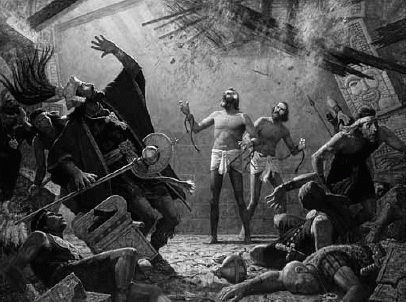
Now, we are at full crescendo in the soundtrack; the priests and the chief judge and the lawyers and the teachers (all the bad guys) are overcome with fear and fall to the earth (still within the prison), the earth shakes mightily, the walls of the prison are rent in twain and everyone inside the prison is crushed by the falling walls.

Queue movie scene above, where the prison walls are crumbling down, huge cement stones are flying everywhere, debris is crushing bad guy after bad guy after bad guy (with screams of anguish, despair, panic, and the very definition of fear on their faces), dust and rocks are flying everywhere and there is no possible way that anyone can survive the destructive carnage brought about by this mighty earthquake.  People nearby can hear the destruction and run to see what is happening only to see Alma and Amulek as they straightway came forth into the city – somehow unscathed.  These people see this scene – two starving, thirsty, beaten, naked, dirty, bloody, and physically weakened men who had been bound in prison and made to endure unspeakable torment – walking calmly from a scene of great destruction… and they run away.  “They fled from the presence of Alma and Amulek even as a goat fleeth with her young from two lions”.  What a great description of real power.  The image of these two was powerful and wonderful and awe inspiring, even as “terrible as an army with banners”. 2  Power that has absolutely nothing to do with physical strength and everything to do with men “becoming as [children], submissive, meek, humble, patient, full of love, willing to submit to all things which the Lord seeth fit to inflict upon them” (Mosiah 3:19).

Alma and Amulek might not have ever known that they would be delivered.  They certainly didn’t have a countdown to deliverance chart in the prison that they were able to track.  They may not have even known until that very moment when ‘the power of God was upon them’ that they would even be delivered at all.  Such is the case with us.  Our tragic and necessary backstory is being written every day.  It will include some trials, some wrestling with the Lord, some taunting, some jeering, some smiting upon our cheeks, and maybe even some hunger, thirst, imprisonment, or silence from the heavens.

After all, our trials are hand crafted just for us – that’s why they are our own.  I don’t get your trials and you don’t get mine – because it’s easy for me to deal with, solve, and overcome other people’s problems, but somehow very difficult to deal with, solve, and overcome my own.  Nephi felt that way when he said, “I was overcome because of my afflictions, for I considered that mine afflictions were great above all” (1 Ne. 15:5) and if Nephi felt that way – I can feel that way.  Our afflictions are tailored specifically to our needs by a loving father in order to maximize effective humility and produce faith and repentance (which leads to positive experience, wisdom, testimony, gratitude, and patience).  So in a sense, our afflictions are and should be ‘above all’ and they cannot be compared to other people’s afflictions (or the outward manifestation of their afflictions, which may seem much easier to bear than our own).   Yet, we should try and recognize our afflictions for what they are – contributions to our backstory that will ultimately lead to the most positive moment of triumph and we can be given the power of God.

So, in the moment when it seems dark, heavy, gloomy, or when people are jeering, smiting, and taunting us, let’s remember that if we are patient, attentive, and humble, the power of God will come upon us – and at some point in the future we will just know when it’s time to stand up.  We will hear (or feel) the hero soundtrack start to play, so “just keep listening, because pretty soon you’ll start to figure out your part”. 3 Let us in that moment, be able to ‘standwith brightness’.  The Lord himself has told us “I will give them power that they may behold and view these things as they are… in this the rising up and the coming forth of my church out of the wilderness – clear as the moon, and fair as the sun, and terrible as an army with banners” (D&C 5:13-14).

Notes

1 – I don’t include it here, but this is a common theme in the world (If God really loves us, why does he allow us to suffer?  The answer is in Alma 14:11 and it has at least 2 parts; 1) Innocent people (especially martyrs), killed by wicked people are ‘received with glory’ into heaven; and 2) the Lord loves us all enough to give us free agency and choice – even if we use or abuse that agency to kill or take a life in order to provide perfect justice to all.  There can be no arguing with the consequences of murder.  In other words, the Lord allows everyone to seal their own fate by their actions, choices, and agency.

2 D&C 5:14.  See also Songs of Solomon 6:4,10

3 – See “Glorious” by David Archuleta

Artwork above taken from LDS.org (1991 Gary L. Kapp)

Share this:

  • Tweet
  • Email a link to a friend (Opens in new window) Email
  • Print (Opens in new window) Print
  • Share on Tumblr
  • Share on Reddit (Opens in new window) Reddit
Like Loading...
← Older posts
Newer posts →
Follow 4 Brothers Blog on WordPress.com

Enter your email address to subscribe to this blog and receive notifications of new posts by email.

Join 169 other subscribers

Recent Posts

  • “One Dollar, Bob”
  • Everlasting Gobstoppers and Foodless Feasts
  • Peanut Butter Cups, Counterfeit Confections, and the Hope for a Superior Interior.
  • How to Grow Grasshopper Legs
  • The Big Box Paradox and the Fable that Labels Enable

Blog Stats

  • 22,761 hits

Instagram

No Instagram images were found.

4 Brothers Blog

4 Brothers Blog

Blogs I Follow

  • The Christensen Six
  • A Cop's Thoughts
  • Gena Standing Out
  • Think Celestial
  • anthology78
  • 4 Brothers Blog

Blog at WordPress.com.

The Christensen Six

A blog about family, faith and fun

A Cop's Thoughts

Life after a shooting

Gena Standing Out

Inspirations and musings of a woman used to standing out from the crowd

Think Celestial

Learning to "Think Celestial" and to "feast upon the words of Christ"

anthology78

4 Brothers Blog

  • Subscribe Subscribed
    • 4 Brothers Blog
    • Join 63 other subscribers
    • Already have a WordPress.com account? Log in now.
    • 4 Brothers Blog
    • Subscribe Subscribed
    • Sign up
    • Log in
    • Report this content
    • View site in Reader
    • Manage subscriptions
    • Collapse this bar
%d